.png)
November 18, 2025 •Greencode
The green data center market represents a rare convergence: a massive, fast-growing industry undergoing fundamental transformation driven by both regulatory pressure and economic logic. For venture investors, particularly those focused on climate tech and digital infrastructure, it's a generational opportunity – but only for those who understand where value will actually accrue.
The global green data center market reached roughly $70-81 billion in 2023 and is projected to exceed $300 billion by 2032. That's an 18% compound annual growth rate in a sector that's infrastructure-critical and increasingly impossible to ignore from a sustainability perspective.
But size alone doesn't guarantee venture returns. The key question: which innovation pockets offer venture-scale outcomes?
This is Part 3 of our Green Data Centers series. Read Part 1 here and Part 2 here.
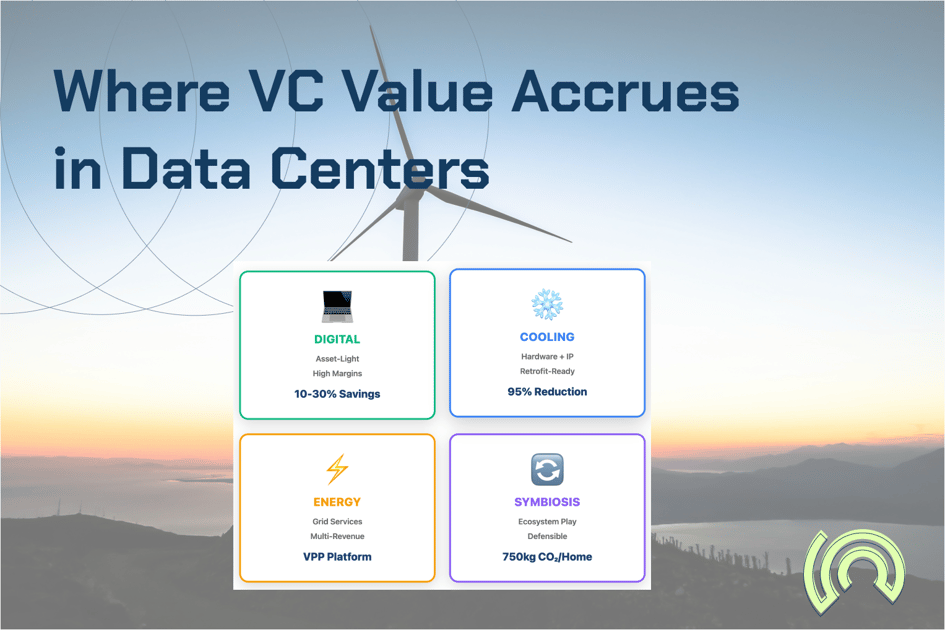
The highest-value opportunities lie in software and AI-driven management systems. These solutions offer everything VCs love: asset-light models, high margins, rapid scalability, and network effects.
Data centers generate massive real-time data streams while operating under tight constraints (uptime, temperature, power budgets). Optimizing these complex systems is fundamentally a software problem. Companies providing "efficiency brains" – AI operations platforms, advanced DCIM, carbon-intelligent workload schedulers – can deploy across thousands of facilities globally without heavy capital requirements.
The economics are compelling. Even a 5-10% energy efficiency improvement at a large facility saves hundreds of thousands of dollars annually. When a software platform can deliver those savings across dozens or hundreds of data centers, the value scales beautifully. Operators get clear ROI, the vendor captures recurring revenue, and both sides win on sustainability metrics.
Startups like CoolGradient (Netherlands), Phaidra, and TycheTools are demonstrating double-digit energy reductions in cooling through AI optimization. Early traction with major colocation providers suggests this software layer will become standard infrastructure – like security monitoring or capacity planning tools are today.
The exit landscape looks attractive. These companies become strategic acquisition targets for multiple buyers: hyperscalers might internalize them for competitive advantage, industrial giants like Schneider Electric or Siemens could acquire them to complement hardware offerings, or they could continue scaling independently toward an IPO as data center sustainability requirements become universal.
By 2027, analysts predict sustainability will be a required criterion in data center infrastructure procurement. Companies enabling that compliance at scale will capture significant value.
Cooling innovations represent a more capital-intensive but still compelling opportunity. These solutions address fundamental physics problems that software can't fully solve, particularly as AI workloads drive computing density beyond what air cooling can handle.
The key to venture returns here is modular, retrofit-compatible solutions. Data centers are conservative environments where reliability is sacred. Solutions that require complete facility redesigns face steep adoption barriers. Those that can slot into existing infrastructure – even incrementally – have dramatically larger addressable markets.
Immersion cooling exemplifies the opportunity. Submer raised $55 million in Series C to scale technology that can cut cooling energy by up to 95% while enabling higher server densities. Asperitas and Iceotope are pursuing similar approaches with different implementation strategies. These companies combine defensible IP (patents on fluids, heat exchangers, system designs) with clear value propositions: lower operating costs, higher capacity, better sustainability metrics.
The market is reaching an inflection point. As next-generation AI chips approach 500+ watts per unit, liquid cooling shifts from "nice to have" to "required for deployment." That creates a wave of demand for solutions that work reliably at scale. First movers with proven technology and customer deployments will likely see rapid growth or strategic acquisitions.
Advanced cooling also enables heat reuse – warm water output is far easier to capture and repurpose than hot air. This creates additional revenue opportunities and strengthens sustainability credentials, particularly in Europe where district heating networks provide ready markets.
The caveat: reliability is non-negotiable. Any solution that increases downtime risk or maintenance complexity will struggle, regardless of efficiency gains. Winners will demonstrate rock-solid performance alongside their innovation.
Data centers are becoming interactive nodes in the energy ecosystem rather than passive loads. Solutions enabling this transformation tap into multiple value streams: reduced energy costs, grid service revenues, resilience improvements, and sustainability benefits.
Smart grid platforms allow facilities to modulate demand in response to grid conditions and energy prices. When renewable generation is high and electricity cheap, increase load. When the grid is stressed or power is expensive, shed non-critical workloads or tap on-site storage. These capabilities generate revenue through demand response programs while improving the facility's carbon footprint and economics.
Battery systems offer particularly interesting opportunities. Sized primarily for backup power, these assets sit idle most of the time. Software platforms that can safely monetize those batteries through frequency regulation or energy arbitrage – without compromising backup reliability – unlock value from existing capital investments. Aggregating multiple facilities creates a virtual power plant that can provide meaningful grid services.
Clean backup alternatives represent a longer-term but potentially transformative opportunity. Microsoft's successful hydrogen fuel cell demonstration shows diesel generators can be replaced. As green hydrogen production scales and costs fall, startups providing fuel cell systems or integration platforms could capture a major market – every data center worldwide will eventually need to replace generators to meet net-zero commitments.
The challenge here is balancing software scalability with hardware/integration complexity. Winners will likely offer platforms that coordinate multiple technologies (on-site solar, batteries, fuel cells, smart grid APIs) rather than point solutions.
The highest long-term value may come from solutions that connect data centers with other sectors, creating multiplied impact and multiple revenue streams.
Heat reuse platforms exemplify this. By connecting data center waste heat with district heating networks, industrial processes, or agricultural applications (greenhouses), these solutions create value on both sides: reduced costs for the data center, clean heat for the consumer, displaced fossil fuel consumption. Once established, these integrated systems are highly defensible – they involve physical infrastructure, local relationships, and operational knowledge that's difficult to replicate.
Heata's model – providing free hot water to homes via distributed servers – addresses computing demand, energy poverty, and emissions simultaneously. While complex to coordinate, such ecosystem plays can achieve monopoly-like positions in their niches with strong policy support (they solve public problems like efficient energy use and community heating needs).
Circular economy platforms that handle IT asset lifecycle, water recycling, or sustainable construction also sit at industry intersections. While sometimes less glamorous than cutting-edge tech, they ride strong tailwinds: regulatory pressure (e-waste directives), cost savings, and growing corporate focus on Scope 3 emissions and resource efficiency.
As a European Green Transition Fund, we are particularly excited about European startups leading in several categories – and actively looking for the next generation of champions:
Submer (Spain) raised $55 million for immersion cooling that cuts energy use dramatically while enabling heat reuse. They're deploying across Scandinavia where both efficiency and heat recovery find ready markets.
Heata (UK) demonstrates creative thinking with distributed servers providing home heating, saving households roughly 750 kg CO₂ and £300 annually while delivering computing capacity.
CoolGradient (Netherlands) targets AI-driven optimization with roof-to-floor visibility, achieving double-digit energy reductions in early deployments.
Asperitas (Netherlands) and Iceotope (UK) are advancing immersion and liquid cooling with modular systems suited to retrofits.
Qarnot Computing (France) markets digital boilers that combine heating and computing, testing in French social housing and municipal projects.
These companies benefit from Europe's lead in sustainability regulation, high energy prices that make efficiency economically compelling, and often natural advantages like cold climates or existing district heating infrastructure.
At Greencode, we're focusing on companies that build digital solutions and enable measurable carbon reduction and resource savings in data centers while offering clear paths to venture-scale returns.
Digital efficiency enablers capture our attention because software scales globally, integrates with existing infrastructure, and delivers immediate value. The optimization layer will become standard across the industry – we want to back the companies building that layer.
Energy integration platforms interest us because they sit at the convergence of two massive transitions: digitalization and decarbonization. Data centers becoming interactive grid nodes creates entirely new categories of value and service providers.
Cross-industry symbiosis solutions align with our systems-thinking approach. While complex to execute, they create multiplied impact and defensible positions.
Throughout, we emphasize pragmatic innovation – solutions that work in today's market conditions, not just theoretical optima. Europe's combination of regulatory push, economic incentive, and natural advantages makes it an ideal proving ground. Technologies validated here can scale globally as other regions face similar pressures.
The green data center transformation represents a rare alignment: urgent climate need, massive market growth, regulatory inevitability, and economic logic all pointing in the same direction. For investors who understand where value will accrue – in intelligence layers, enabling technologies, and ecosystem integration – the opportunity is generational.
The question isn't whether data centers will go green. It's who will capture the value from making it happen.
At Greencode, we're actively seeking founders building in these spaces. If you're working on digital optimization, advanced cooling, energy integration, or circular solutions for data centers, let's talk: hello@greencode.vc
This blog post is Part 3 of our Green Data Centers series. Part 1 is here. Part 2 is here.